
AI Summary
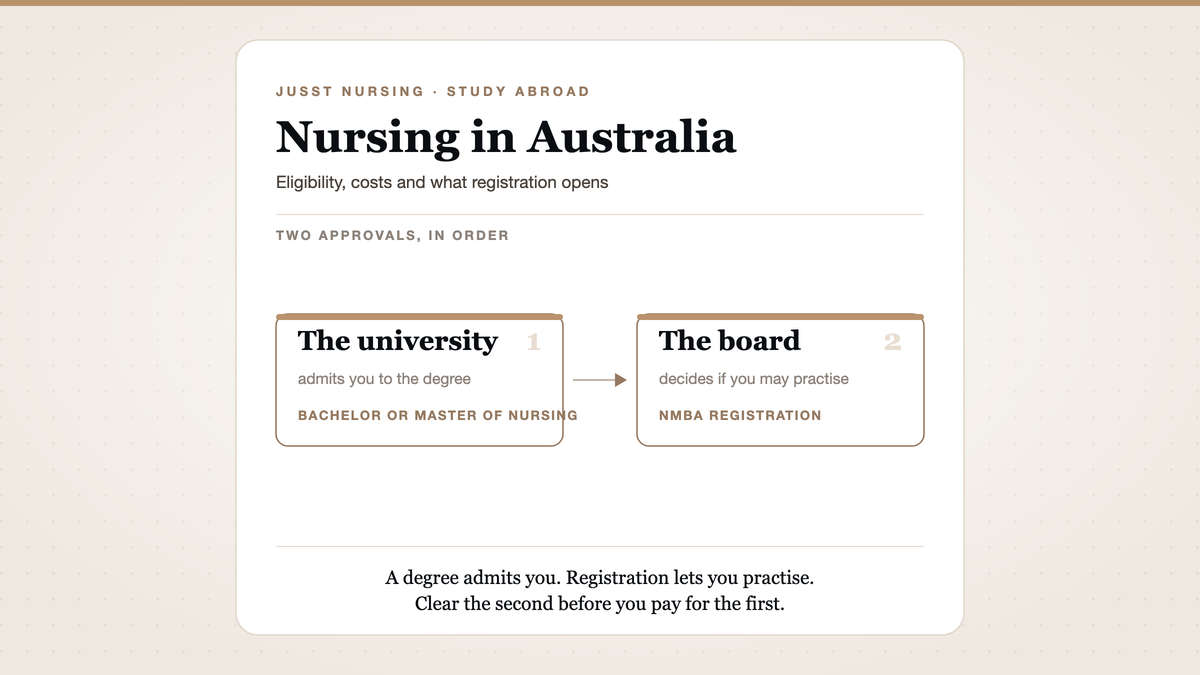
Nursing in Australia runs through two separate approvals. A university admits you to a Bachelor or Master of Nursing, and the Nursing and Midwifery Board of Australia decides whether you can register and practise. English sits on the registration standard rather than the university offer, and it is the requirement Indian applicants most often underestimate. Costs split into tuition, health cover and a living figure the visa requires you to evidence. Registration, not graduation, is what opens employment, so confirm the assessment route that applies to your qualification before you pay a deposit.
Nursing in Australia is decided by two authorities, not one, and the order you satisfy them in decides how long the whole thing takes. A university admits you to a degree. The Nursing and Midwifery Board of Australia decides whether that degree lets you practise. Indian students who read only the admission page plan the first year well and the third year badly. This guide sets out the eligibility gates, what the money actually goes on, and what registration opens once you hold it. If you are still choosing a country, our page on how to study nursing in australia sits alongside the same breakdown for the UK and Canada.
Two approvals, and why the order matters
Every question about nursing in Australia resolves to one of two bodies. Universities control admission to the degree. The Nursing and Midwifery Board of Australia, administered through AHPRA, controls registration, and registration is what an employer checks. The two sets of requirements overlap but they are not the same, and the board’s are the stricter of the pair.
This matters because a student can meet an offer condition, arrive, study for three years, and then discover the English evidence accepted at admission does not satisfy the registration standard. The fix at that point costs months. The fix before departure costs one test sitting.
| Route | Who you are | What you clear |
|---|---|---|
| Student route | School leaver or graduate with no nursing qualification | University admission, then registration on graduation |
| Registration route | Already a registered nurse in India | The board’s assessment for internationally qualified nurses |
If you already hold an Indian nursing registration, you are on the second route and a full degree may be the wrong purchase. Our comparison of the USA, UK and Canada for Indian nurses covers how the equivalent assessments differ by country.
Eligibility for nursing in Australia: the requirements that actually gate you
Academic eligibility for nursing in Australia is the ordinary part. A Bachelor of Nursing takes three years and asks for completed Class 12 with science subjects. A Master of Nursing that leads to first registration usually runs two years and asks for a completed bachelor degree, sometimes in any discipline, sometimes in a health field. Entry scores are published and stable.
English is the requirement that moves outcomes. It is set by the board as a registration standard, so it applies whether or not your university waived a test at admission. The accepted tests are named, minimum scores apply to every component rather than the overall figure, and results carry an expiry. A student who scores well overall and drops one band below the minimum has not met it.
| Requirement | Set by | What people get wrong |
|---|---|---|
| Academic entry | The university | Little, it is published clearly |
| English | The board | Assuming the offer condition is the standard |
| Assessment for qualified nurses | The board | Assuming an Indian registration transfers directly |
| Visa | Home Affairs | Leaving funds evidence to the last month |
Nurses already registered in India face an outcome based assessment rather than a fresh degree, and it runs in stages, a written component followed by a practical examination. Our guide to English test requirements for nurses sets out the component minimums that apply across destinations, since this is the same trap in every country.
What it costs, and which figures are fixed
Cost conversations about nursing in Australia usually stop at tuition, which is the number that varies most and matters least for planning, because it is the one the university states plainly on the offer. The figures that catch people are the ones attached to the visa rather than the course.
| Line | Fixed or variable | What to confirm |
|---|---|---|
| Tuition | Variable by university and degree | The per year figure and whether it rises annually |
| Overseas Student Health Cover | Required for the visa | Whether the quote covers your full visa length |
| Living costs | A published figure you must evidence | The current amount, which is revised |
| Registration and assessment fees | Separate from tuition | Which assessment stages apply to you |
The living cost requirement is set by the Student visa subclass 500 rules and it is revised, so quote it from the current page rather than from a forum post or an older guide. Registration and assessment fees sit outside tuition entirely and are easy to leave out of a budget built from a university page. For the wider picture across destinations, our breakdown of nursing courses abroad and their costs compares the full run rather than the headline fee.
Work rights offset part of this, and nursing students are usually able to work limited hours during term. Treat that as a reduction in pressure, not as a funding plan, because placement blocks are the periods when hours are hardest to keep.
One more line deserves its own thought. Clinical placement is a compulsory part of the degree, it is scheduled by the university rather than by you, and it can sit in a different city from the campus. Where that happens, travel and short term accommodation are real costs that no fee page lists. Ask the admissions team where placements for your intake have run in recent years, because the honest answer changes the budget for nursing in Australia more than a difference of a few thousand dollars in tuition.
Career opportunities after registration
Registration is the thing that converts a degree into employment. Once the board grants it, you hold a general registration as a registered nurse and can work across public and private hospitals, aged care, community health and remote services. Specialisation follows practice rather than preceding it, so most nurses register first and specialise afterwards through further study or supervised experience.
Demand is not uniform. Aged care and regional services carry the steadiest shortages, and regional work often attracts incentives that metropolitan roles do not. Indian nurses who arrive expecting a metropolitan teaching hospital as a first post frequently take longer to place than those who treat regional experience as the entry point it is.
Progression from a first post runs through clinical specialisation, then senior clinical or education roles. A first registration is a licence to practise rather than a career ceiling, and the timeline from registration to a senior clinical position is measured in years of practice, not in additional qualifications alone. Our overview of studying nursing abroad sets out how these ladders compare between systems.
The question that follows a first job is usually residence rather than promotion, and the two are connected. Nursing has appeared on Australian skills lists for years, which is why the profession is often described as a settlement route. Treat that as context and not as a guarantee. Lists are revised, and the requirements attached to them are decided by immigration policy rather than by your employer or your university. Plan the degree on its own merits, keep your registration current, and read the migration question separately when you are closer to it.
What stays constant across all of this is that employers hire registered nurses. Every opportunity described above sits behind the same gate, which is why the sequence set out at the start of this guide is worth more attention than the university rankings that usually dominate the decision.
Three mistakes that cost Indian applicants a year
The first is treating the university offer as the full set of requirements. It is not, and the board’s standards are the ones that decide practice. Read both before you accept.
The second is sitting an English test late. Component minimums, expiry dates and a possible resit all sit inside the same window as your application, and a single band below the minimum sends you back for another sitting. Book it early enough that a resit still fits.
The third is budgeting from tuition alone. Health cover, the evidenced living figure and registration fees are all real, all separate from the course, and all payable on their own schedule.
None of these are difficult requirements. They are simply requirements that sit with different bodies, on different timelines, and reading only one of them is what turns a straightforward plan for nursing in Australia into a lost intake. Confirm the registration standard and the assessment route that applies to you before any deposit leaves your account, and the rest of the process is ordinary paperwork.